
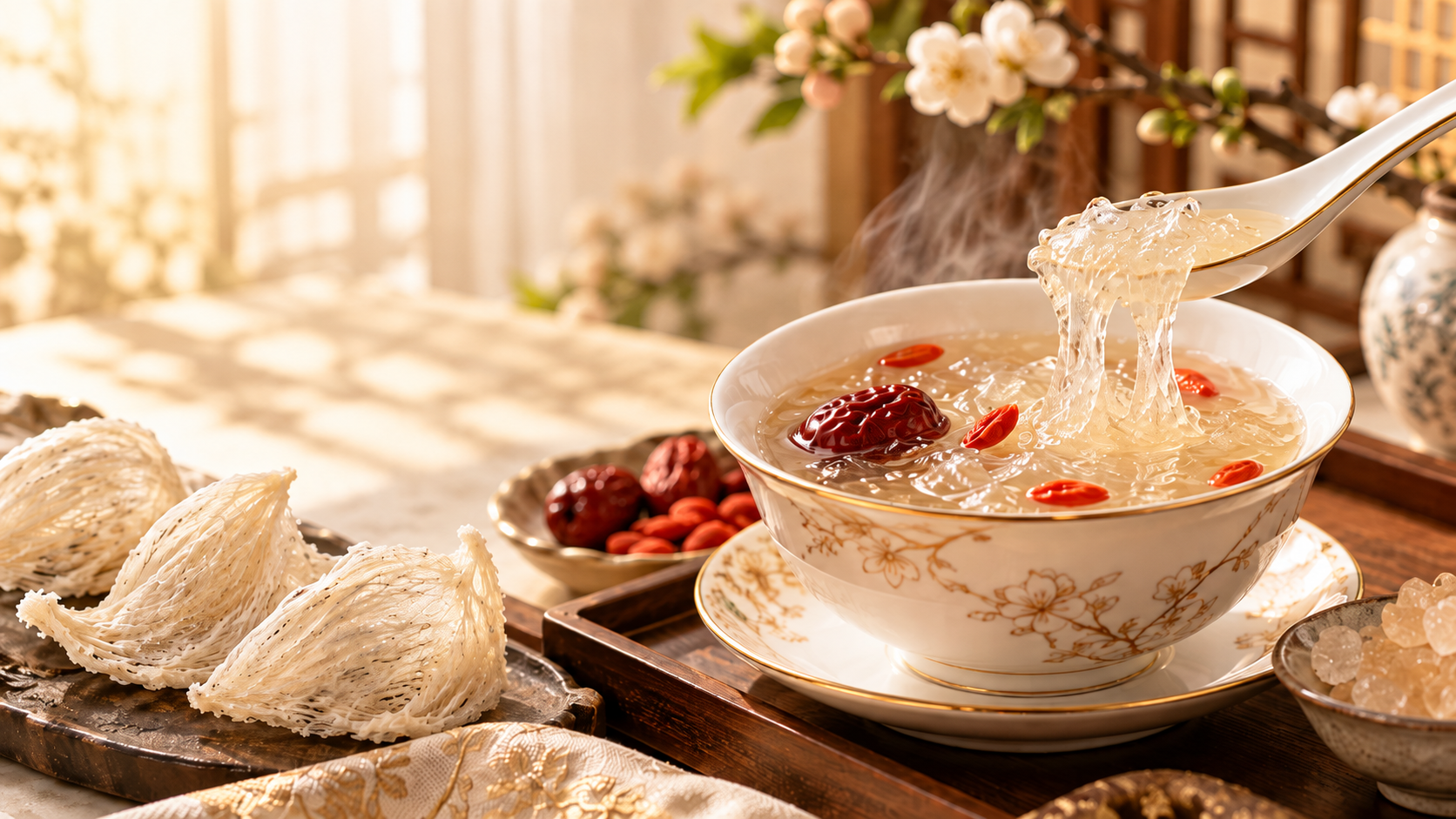
Every year, as the weather cools, SoupTok fills with steaming bowls of broth, congee and noodles. Tucked among them is a dish that makes people stop scrolling. Bird’s nest soup, made from the dried nest of a small bird called the swiftlet, has graced Chinese banquet tables for centuries. Now a new audience of curious, wellness-minded viewers wants to know what it is, how it tastes and why a single bowl can cost as much as a fine dinner. As a producer of hand-cleaned Indonesian swiftlet nests, we’re happy to explain.
Key insights
- Bird’s nest soup is made from the edible nest of the swiftlet, which the bird builds almost entirely from its own hardened saliva.
- The nest is rich in glycoprotein, and sialic acid (N-acetylneuraminic acid) is its signature component.
- An authentic nest has a natural ivory tone. Brilliant white nests may have been chemically whitened, so lab certificates matter more than appearance.
- Price depends on grade, cleaning labour and origin, and demand traditionally peaks around Lunar New Year.
What Is Bird’s Nest Soup?
Bird’s nest soup is a delicate sweet or savoury soup made from the edible nest of the swiftlet. Once soaked and gently simmered, the dried nest softens into silky, translucent strands.
The nest comes mainly from the edible-nest swiftlet (Aerodramus fuciphagus), a small bird native to Southeast Asia. Merriam-Webster defines the dish as a soup made with a swiftlet nest built from a glutinous secretion of the bird’s salivary glands, and dates the term in English to 1744. There are no twigs or leaves involved. The nest itself is the ingredient.
Because swiftlets look a little like swallows, many menus and grocers call it swallow nest soup. In Chinese it is yàn wō. Today most premium nests are harvested from purpose-built swiftlet houses rather than caves, and Indonesia is the world’s largest producer. Alba sources house nests from Java, Kalimantan and Sulawesi.
Why Chinese Bird’s Nest Soup Is a Celebration Dish
In Chinese food culture, a bird’s nest is a gift of care. It appears at wedding banquets, it is shared during Lunar New Year, and it is often prepared for elders and new mothers. A beautifully boxed nest says “I want the best for you” in a way few other foods can.
That meaning shapes demand. Search interest for bird’s nest soup in the United States climbs through autumn and peaks in January, right before the new year. In restaurants, a bowl typically costs somewhere between US40andUS100.
What Does Bird’s Nest Soup Taste Like?
Bird’s nest soup tastes mild and clean, with a faint, slightly sweet note of its own. People love it for its texture, which is silky and gently springy, somewhere between egg white and soft jelly.
Because the nest is subtle, the cook decides the flavour. The classic dessert version uses rock sugar, and often pandan, red dates or goji berries. The savoury version is served in clear chicken broth with ginger, sometimes finished with a swirl of egg.
How Restaurants Prepare It
- Soak the cleaned nest in cool, clean water until it softens and expands, usually a few hours.
- Drain and rinse, then pick out any fine feathers that remain.
- Double-boil the nest gently in a covered pot over simmering water, around 30 minutes for most cleaned grades.
- Add rock sugar or warm broth towards the end so the strands keep their shape.
Gentle heat is the secret. Long, hard boiling breaks the strands down and changes the texture you’re paying for.
What Makes the Nest So Valued?
Swiftlet nest is made mostly of glycoprotein, and its signature component is sialic acid. Researchers report that the purified glycoprotein contains roughly 14% sialic acid, 63% protein and 21% saccharides.
Sialic acid in bird’s nests occurs as N-acetylneuraminic acid, a compound that also appears naturally in human milk. It is so characteristic of the nest that analysts use it as a marker of genuine content. Many buyers ask about it when judging quality.
Laboratory and animal studies have explored antioxidant and anti-inflammatory activity linked to sialic acid, lactoferrin and other glycoproteins in the nest. A 2025 review in the International Journal of Molecular Sciences summarises this work. Most of it is early-stage research, and well-designed human trials are still limited. We see bird’s nest as a nourishing traditional food with intriguing science behind it. For a closer look at the studies, read our guide to the science behind edible bird’s nest benefits.
How to Recognise Authentic, Hand-Cleaned Nest
High value attracts shortcuts, so a few myths are worth clearing up.
The whitest nest is the best nest
Natural swiftlet nests have a soft ivory or cream tone. Industry testing laboratories note that some nests are treated with hydrogen peroxide to whiten them. A brilliant, paper-white colour can therefore be a reason to ask questions. At Alba, every nest is cleaned by hand with clean water and tweezers, with no chemical bleaching. You can follow each step on our production process page.
You can spot a fake by looking closely
Researchers have found that karaya gum, red seaweed and tremella (white) fungus are among the most common materials mixed into retail nests. A 2022 study in Foods confirmed that some of these additions look identical to genuine nests. Laboratory analysis, not appearance, is the reliable check. That is why we publish our product certifications and lab results.
Cave nests are always superior
Cave nests have romance, but most of the world’s premium nests now come from well-managed swiftlet houses. Houses allow regular, careful harvests after the young birds have fledged, and they give buyers traceable origin.
Birds Nest Soup Price and What Drives It
The price of bird’s nest soup reflects three things. These are the grade of the nest, the hours of hand-cleaning behind it and where it comes from.
| Grade | What it looks like | Best for |
| Bowl | Whole, intact cup shape | Signature servings and gifting |
| Triangle | Corner nests with a firm structure | Restaurant soups and desserts |
| Strip | Long, clean strands | Everyday soups, drinks and food manufacturing |
Cleaning is the hidden cost. Researchers estimate that it can take one person eight hours to clean just ten nests. For restaurants, importers and brands, buying graded nest directly from the producer keeps quality consistent and the margin where it belongs. Browse our premium bowl, triangle and strip nests to compare grades.
Frequently Asked Questions
Is bird’s nest soup made from a real bird’s nest?
Yes. It is made from the nest of the edible-nest swiftlet, which the bird builds from its own saliva. After cleaning, the nest contains no twigs, leaves or bird tissue.
How can I tell if a nest was cleaned without bleach?
Look for a natural ivory tone, a faint clean scent and strands that expand evenly when soaked. Then ask the supplier for independent lab results. A trustworthy producer will share them gladly.
Does a bird’s nest contain sialic acid, and what does it do?
Yes. Sialic acid is the signature component of swiftlet nests. Laboratory and animal research has explored its antioxidant and anti-inflammatory activity. Human evidence is still developing, so we describe a bird’s nest as a nourishing food rather than a treatment.
Can bird’s nests be imported safely into the United States and Australia?
Yes, when it comes from a compliant exporter. US entry requires heat treatment that meets USDA APHIS conditions, and Australia applies its own import conditions under the Biosecurity Act 2015. Alba operates an FDA-registered facility, holds NKV veterinary certification in Indonesia and prepares nests to meet both markets’ requirements.
Bring Authentic Bird’s Nest to Your Table
Whether you’re cooking your first bowl for Lunar New Year or sourcing a nest for a restaurant menu, quality starts at the source. Contact our team for wholesale pricing, samples and documentation for your market.