
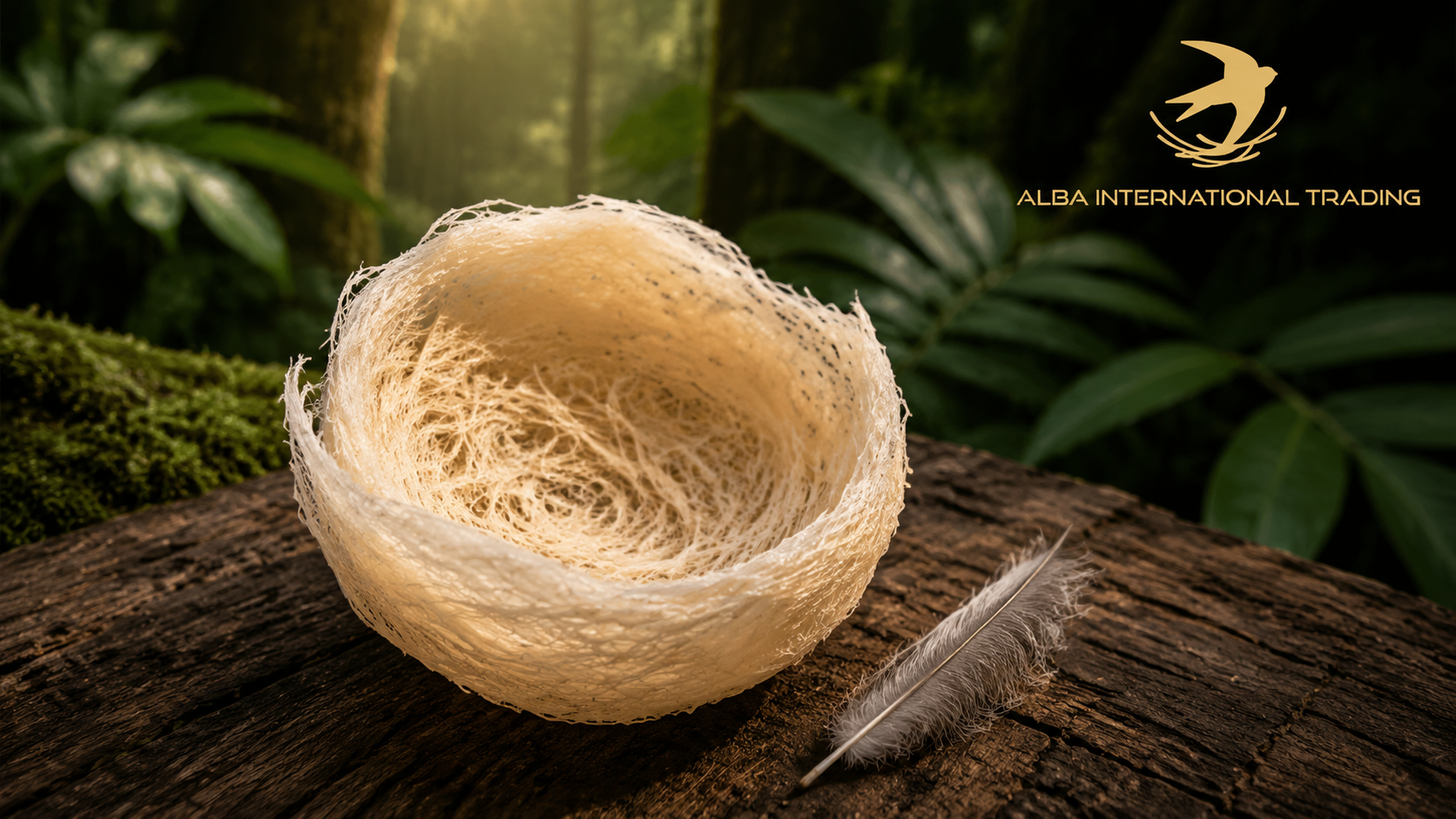
Buyers and connoisseurs often single out Kalimantan bird’s nest as one of the most distinctive edible bird’s nests from Indonesia. The reason comes down to geography as much as tradition. Borneo’s ancient rainforest, its river systems, and its humidity levels create a very specific environment for swiftlets, one that shapes the texture, purity, and mineral profile of every nest harvested there. For wholesale buyers trying to understand why sourcing region matters so much in this industry, Kalimantan is one of the clearest examples.
In this article, we’ll look at what makes nests from this part of Indonesia stand apart and how the local climate and swiftlet population influence quality. We’ll also explain why Alba Bird Nest includes Kalimantan among its core sourcing regions.
Why Geography Shapes Bird’s Nest Quality
Edible bird’s nest is built entirely from swiftlet saliva, hardened over weeks into a cup-shaped structure. The bird produces this saliva in direct response to its environment: humidity, temperature, insect availability, and mineral content in the air and water. Because of this, the region where swiftlets build the nest has a real, measurable effect on the finished product. This is one of the main reasons the trade distinguishes nests by origin rather than treating them as an interchangeable commodity.
Borneo, and the Indonesian province of Kalimantan specifically, offers a particular combination of factors that swiftlets respond well to. These include dense tropical rainforest cover, consistently high humidity, and a river-fed ecosystem that supports a large, stable insect population for the birds to feed on. These conditions tend to produce nests with a firmer structure and a cleaner, whiter-to-cream base coloring before processing, which is part of why Kalimantan bird’s nest commands strong interest among buyers who are particular about consistency.
The Borneo Rainforest Advantage
Kalimantan makes up the Indonesian two-thirds of the island of Borneo, one of the oldest rainforests on earth. That age and density matter for swiftlet colonies in a few practical ways.
- Humidity stability. The rainforest canopy keeps humidity levels high and relatively constant year-round, which supports steady nest-building conditions rather than the seasonal swings seen in more open or coastal environments.
- Insect biodiversity. A mature rainforest ecosystem supports a wider range of insect life, giving swiftlets a more varied and abundant food source, which in turn supports healthier colonies and more consistent nest production.
- Lower human disturbance in wild habitats. Parts of Kalimantan’s swiftlet habitat remain less developed than more urbanized nesting areas elsewhere in Southeast Asia, which can mean less environmental stress on wild colonies.
These factors don’t just affect volume, they affect the physical characteristics of the nest itself, from shape retention to how easily impurities can be hand-cleaned out during processing.
What Sets a Kalimantan Nest Apart
Buyers who work regularly with Indonesian bird’s nest often point to a few recurring qualities in nests sourced from this region:
- Bowl-shaped structure and size. Kalimantan nests are frequently associated with an elegant, well-formed bowl shape and larger overall size, which is prized in both retail presentation and culinary use.
- Natural texture. A soft yet resilient texture that holds together well during soaking and cooking, without the nest breaking down too quickly.
- Purity potential. Because of the habitat conditions described above, nests from this region can be cleaner at the point of harvest, which supports a genuinely natural, chemical-free hand-cleaning process rather than relying on bleaching to mask impurities.
It’s worth noting that quality still depends heavily on how a nest is harvested and processed after leaving the forest. Region provides the raw material advantage, but sourcing partners, cleaning methods, and certification are what turn that advantage into a reliable, export-ready product.
How Alba Sources Kalimantan Bird’s Nest Responsibly
At Alba Bird Nest, Kalimantan is one of several Indonesian regions, alongside East Java, Sulawesi, NTB, and NTT, that make up our sourcing network. We don’t rely on a single region alone, but Kalimantan plays an important role in the diversity and quality of what we bring to market.
Every nest we source, including those from Borneo’s forests, goes through the same standards: naturally harvested from swiftlet habitats, hand-cleaned without bleach, chemicals, or preservatives, and processed to preserve the nest’s natural texture and nutritional value. You can see the full process on our production process page, and the documentation behind it on our product certification page, which covers our FDA facility registration and Agricultural Quarantine Agency compliance.
This matters particularly for Kalimantan bird’s nest, since sourcing from remote, forest-based habitats requires careful supply chain management to maintain traceability and consistency from harvest through export.
A Regional Approach to Quality
Understanding why Kalimantan’s nests differ from those sourced elsewhere is really a lesson in how this industry works as a whole: origin, climate, and harvesting practice all compound to determine the final product a buyer receives. It’s the same principle that separates any premium Indonesian bird’s nest from a lower-grade, chemically treated alternative, the environment gives the nest its raw potential, and responsible sourcing and processing protect it.
For wholesale buyers, distributors, and businesses evaluating suppliers, this is exactly why sourcing region should be part of the conversation, not an afterthought.
If you’d like to learn more about our full sourcing regions and product range, visit our products page, or get in touch through our contact page to request a quote for Kalimantan bird’s nest and other Indonesian origins.
1 Comment