
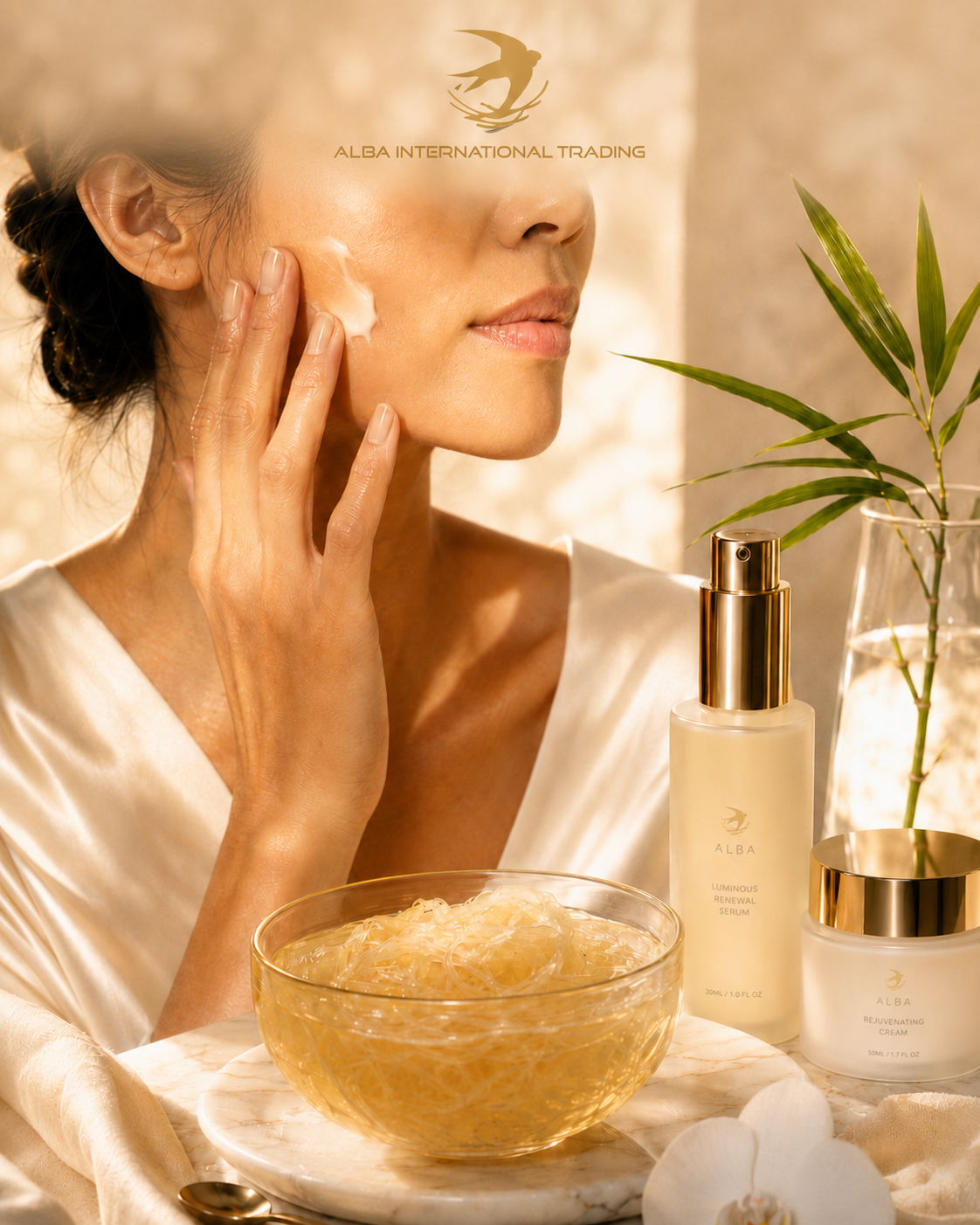
Sellers often market edible bird’s nest as a collagen booster. So the bird nest collagen benefits people ask about deserve a check against real evidence. Here is the short version. Bird’s nest is not a collagen supplement in the way the label suggests. It does not deliver collagen that your skin then absorbs and uses. Instead, it carries compounds like sialic acid, amino acids and growth-factor-like activity. Lab and animal studies link these to skin repair and collagen pathways. A few human trials back parts of the picture. The results so far are real but modest, and the research is still early.
This article covers what the studies say. It shows where the evidence is strong, and where marketing runs ahead of the science.
What bird’s nest is, and why “collagen” is the wrong word
Swiftlets make edible bird’s nest from their hardened saliva. It is roughly half protein by weight. It also carries an unusual amount of sialic acid (N-acetylneuraminic acid), plus amino acids and glycoproteins.
Here is the honest framing that most product copy skips. Eating collagen, from any source, does not send collagen straight to your skin. Your gut breaks the protein into amino acids and short peptides first. So the useful question is not how much collagen sits in bird’s nest. It is whether the compounds in bird’s nest support the skin’s own collagen and moisture processes. That is where the research points.
How sialic acid and EGF may support skin
The proposed mechanism has two parts. Both come mainly from cell and animal studies, not large human trials.
Sialic acid is the compound most people know bird’s nest for. In lab models it shows antioxidant activity and interacts with skin cell function. One 2021 study tested a standardised bird’s nest extract on skin cells. It helped protect them against UVB-driven oxidative stress and photoaging (Kim et al., 2021, Antioxidants). Other work found that bird’s nest supports skin moisture by regulating filaggrin. Filaggrin is a protein tied to the skin barrier (Lai et al., 2021).
Bird’s nest also carries epidermal growth factor (EGF) activity. EGF acts on receptors that influence keratinocytes and fibroblasts. Those are the cells that build collagen. A 2026 study mapped part of this route. It reported that dietary bird’s nest improved skin hydration through the EGFR-AQP5 pathway in mice. The same paper added a human component measuring hydration, elasticity and dermal collagen (Wang et al., 2026, Journal of Functional Foods).
The takeaway is simple. A plausible, partly evidenced route exists for bird’s nest to support collagen and skin moisture. It works by signalling and supplying raw materials. It does not deliver collagen directly.
What the human trials show, mixed results included
Honest reporting matters most here. The human evidence is thinner and more mixed than most product pages admit.
The most cited human trial dates from 2022. It ran as a randomised, double-blind, placebo-controlled study in women aged 40 to 60. Each group held 43 participants. They took 100 mg of bird’s nest extract or placebo daily for 12 weeks (Kim et al., 2022, Frontiers in Pharmacology). The extract improved skin wrinkles against placebo, and no one reported adverse reactions. One caveat is worth knowing. In the same trial, skin elasticity did not improve against placebo, and moisture showed no clear benefit. So the fair reading is improved wrinkles, mixed results elsewhere.
Newer human research is starting to appear. It includes further randomised trials on bird’s nest and skin ageing in women, plus the 2026 hydration study above. These point in a positive direction on hydration and collagen density. Still, the number of well-controlled human trials stays small.
A 2025 review in Discover Food (Springer Nature) is worth a mention. It summarised bird’s nest as a source of sialic acid, amino acids, collagen and glycoproteins. The review linked these to tissue repair, skin rejuvenation and anti-ageing (2025 review). A review describes what the wider literature suggests. It is not proof on its own, and readers should not treat it as proof.
The evidence, in one place
- Strong (lab and animal): sialic acid and EGF activity, antioxidant effects, moisture support via filaggrin, and collagen pathways in cell and mouse studies.
- Emerging (human): a few randomised trials showing better wrinkles and hydration, with mixed results on elasticity and moisture.
- Not established: large, repeated human trials with big, consistent effects. Treat online figures like “collagen up 18 percent” with caution.
Bird’s nest versus collagen supplements
People often weigh bird’s nest against collagen powders. Here is a fair comparison, not a sales pitch.
Collagen supplements provide hydrolysed collagen peptides. Your body absorbs these as amino acids and peptides. Some research suggests a portion may signal skin cells to make collagen. The effect sizes stay generally modest. The evidence base is larger than bird’s nest, but researchers still debate it.
Bird’s nest works differently. It does not try to deliver collagen at all. It supplies sialic acid, amino acids and growth-factor-like compounds that may support your own skin cells. Think of collagen powder as pre-made building blocks. Think of bird’s nest as raw materials and signals. Neither is a shortcut. Neither replaces sun protection, sleep and a sensible diet. Those carry far stronger evidence for skin ageing than any supplement.
How much, and how long
Human trials have used different formats. Some used 100 mg of a concentrated extract daily. Others used larger servings of stewed bird’s nest. That range makes a single correct dose hard to state. Across the studies, a few patterns hold up:
- Benefits, where they showed, took weeks not days.
- Consistency mattered more than a large occasional serving.
- Participants tolerated bird’s nest well, and the trials reported no significant adverse reactions at the tested doses.
Planning to try bird’s nest for skin? Treat it as a long-term food habit, not a quick fix. Give it two to three months before you judge any effect.
A note on safety
Bird’s nest is a recognised food allergen. Doctors have documented allergic reactions, including serious ones in sensitised people. New to it? Start small. Avoid it if you have a known bird’s nest or related allergy. Bird’s nest is a traditional food, not a medicine. It should not replace treatment for any skin or health condition. Pregnant, breastfeeding, or managing a health condition? Speak with a healthcare professional first.
The bottom line
Do bird nest collagen benefits hold up? Partly, and honestly. Bird’s nest holds no absorbable collagen. It does carry compounds with a plausible role in skin repair, moisture and collagen pathways. Lab and animal research supports the mechanism fairly well. Human evidence is promising but limited, and some results are mixed. Anyone promising dramatic, guaranteed results with exact numbers is overstating the science.
So where does that leave you? Bird’s nest is a traditional food with a growing evidence base and a good safety record at normal servings. That makes it worth trying with realistic expectations. It is not a miracle.
About Alba Bird Nest
Alba supplies premium, ethically sourced edible bird’s nest from Kalimantan, Indonesia. We test each batch for sialic acid content and purity. Want to add bird’s nest to a long-term skin and wellness routine? See the Alba bird’s nest range or read about our sourcing and quality standards.
For wholesale and export enquiries, contact the Alba team for pricing and certification details.
Frequently Asked Questions
Does bird’s nest contain collagen you can absorb? Not in a usable way. Digestion breaks any collagen into amino acids first. Think of bird’s nest as a source of sialic acid, amino acids and growth-factor-like compounds. These may support your skin’s own collagen processes.
Is there real clinical evidence for bird’s nest and skin? Yes, but it is early. A 2022 randomised, placebo-controlled trial reported better wrinkle measures in women over 12 weeks. The same trial showed mixed results on elasticity and moisture. Lab and animal studies support the mechanism more strongly than human trials do so far.
How long until I might see results? In the trials that reported benefits, effects showed over weeks. The main human trial read its results at 12 weeks. Treat it as a two to three month habit, not a quick fix.
Is bird’s nest safe to eat regularly? Participants tolerated it well in trials, and researchers reported no significant adverse reactions. It is still a known allergen. Start small if you are new to it. Avoid it if you have a bird’s nest allergy.
Is bird’s nest better than a collagen supplement? They work differently, and neither is a proven shortcut. Collagen powders supply peptides directly. Bird’s nest supplies sialic acid and signalling compounds. The human evidence for both is modest.
This article gives general information, not medical advice. Bird’s nest is a traditional food, not a treatment for any condition. Consult a qualified healthcare professional for advice specific to you.