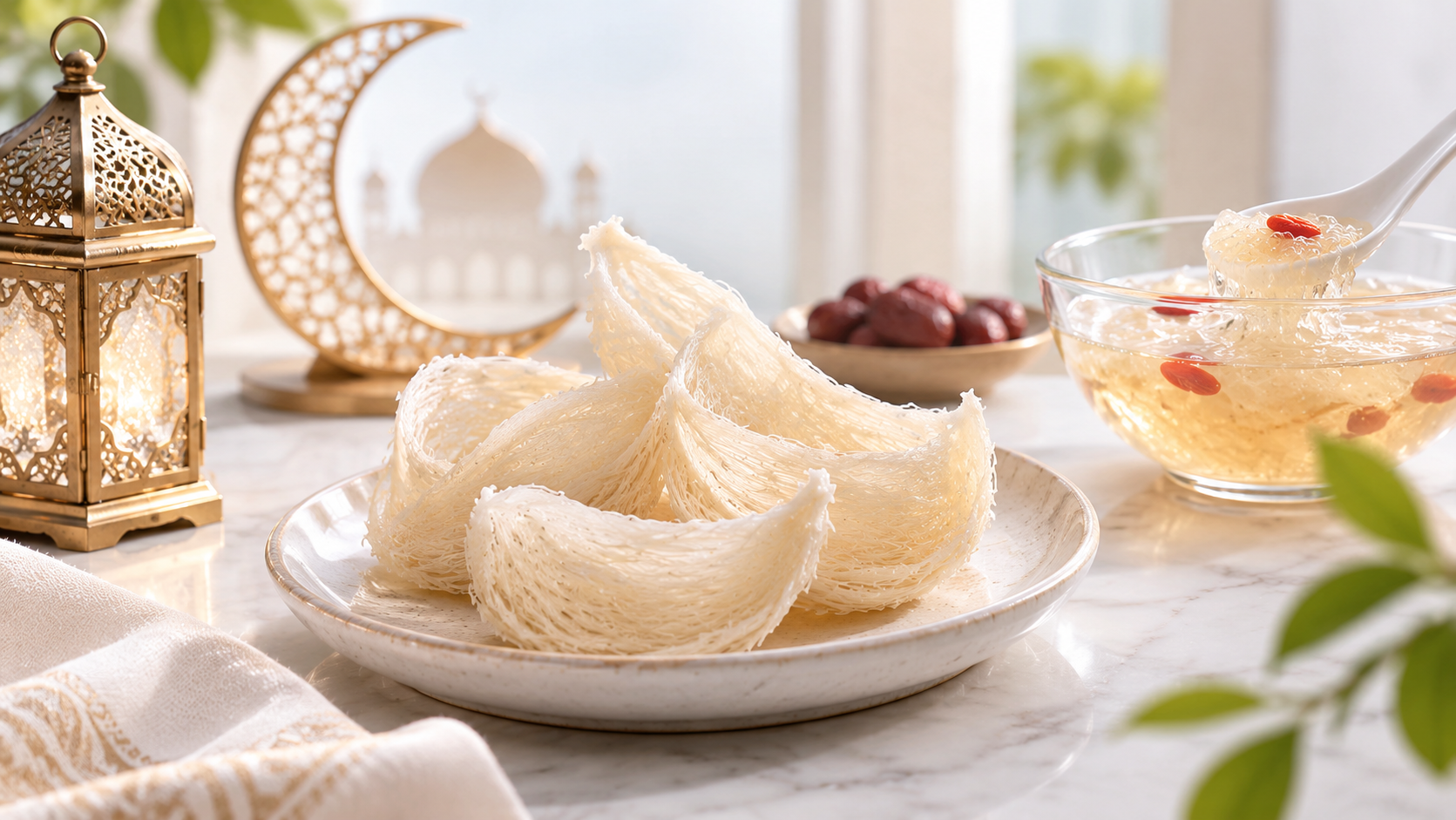
Each year, as Ramadan approaches, families start planning nourishing foods for suhoor and iftar, and one question comes up again and again. Is bird nest halal? Searches for the answer climb every winter and peak during the holy month, from shoppers in Jakarta and Singapore to Muslim families in the United States. The short answer is reassuring. Here is what Islamic scholars say, why careful cleaning matters, and how to choose a bird’s nest with confidence.
Key insights
- Islamic scholars widely regard edible bird’s nest as halal, because it is made from the saliva of the swiftlet, a permissible bird.
- The main halal consideration is cleanliness. Feathers and debris from the nest must be removed thoroughly before it is eaten.
- Malaysian researchers note that tiny traces invisible to the eye may be excused under Islamic jurisprudence, which makes careful hand-cleaning especially important.
- Halal certificates are issued by recognized bodies such as BPJPH in Indonesia and JAKIM in Malaysia, so wholesale buyers should request documentation for their market.
Is Bird Nest Halal?
Yes, edible bird’s nests are generally considered halal. It is made from the hardened saliva of the swiftlet, and Islamic scholars hold that the saliva of permissible birds is pure and may be eaten.
The edible-nest swiftlet (Aerodramus fuciphagus) builds its nest almost entirely from strands of its own saliva. There is no meat, blood, or slaughter involved. A published fatwa from IslamWeb confirms that bird’s nest soup is permissible. It rests on two principles. Food is lawful unless clear evidence forbids it, and the saliva of permissible birds is pure.
That same reasoning explains why bird’s nest has been enjoyed for generations across Muslim-majority communities in Southeast Asia, where most of the world’s supply is produced.
Why Cleanliness Matters for Halal Bird Nest
A raw nest is not ready to eat. It contains fine feathers and other debris that must be removed, and thorough cleaning is the key step that keeps a halal bird nest pure.
In Islamic jurisprudence, impure matter is known as najis. A 2024 study published in Sains Malaysiana explored this question directly. Researchers used laboratory methods to detect feather and droppings residue in bird’s nest by-products. They explained that when any trace is minimal and invisible to the naked eye, it may be excused under the principle of small amounts that custom overlooks. The same study notes that such products can then be considered for halal certification by Malaysian authorities.
In practice, that places great weight on how carefully a nest is cleaned. Malaysia even has a dedicated good manufacturing standard for bird’s nest processing, MS 2333, which sets expectations for cleaning raw nests.
At Alba, every nest is cleaned by hand with purified water and fine tweezers under bright light. No bleach or chemical additives are used at any stage. You can follow each step on our production process page.
Halal Certification Explained
A halal certificate is an official document confirming that a product and its processing meet halal requirements. For a bird’s nest, certification depends on the processor, not just the ingredient.
Because the nest itself is permissible, certification focuses on everything that happens after harvest. Auditors look at cleaning methods, hygiene, equipment, packaging, and any ingredients added to finished products such as drinks or desserts.
Different markets rely on different authorities. In Indonesia, halal certificates are issued by BPJPH, the national halal agency, with religious rulings from MUI. In Malaysia, JAKIM leads certification, and the country’s National Fatwa Council has addressed swiftlet nests specifically. In the United States, halal certification is handled by private certifying organizations rather than a federal agency.
For wholesale buyers, the practical step is simple. Ask your supplier which halal documentation is available for your destination market before you place an order.
Myths About Bird’s Nest and Halal Status
Bird’s nest contains animal meat
It does not. The nest is made of saliva, mostly glycoprotein, with no flesh or blood. Its signature compound is sialic acid, a natural sugar acid that scientists also use as a marker of genuine nest content. You can learn more in our guide to sialic acid in bird’s nest.
A whiter nest is a cleaner, purer nest
Brilliant white does not mean cleaner. Natural swiftlet nests have a soft ivory tone, and testing laboratories have documented nests whitened with hydrogen peroxide. For halal-conscious buyers, a naturally cleaned nest is the better choice, with no harsh chemicals involved.
Every bird’s nest product is automatically halal
The nest itself is permissible, but finished products may contain other ingredients. A bottled bird saliva drink, for example, may include sweeteners, flavorings, or stabilizers. Always check the full ingredient list and look for a recognized halal logo on ready-to-drink products. Our bird nest drink guide explains how to read those labels.
Enjoying Bird’s Nest During Ramadan
Bird’s nest is a gentle, light food that fits naturally into the rhythm of Ramadan. Many families enjoy it warm after breaking the fast, often double-boiled with a little rock sugar, red dates, or pandan. Others prefer a chilled bird’s nest dessert at iftar gatherings.
Its value comes from its glycoproteins, amino acids, and sialic acid. We see it as a nourishing traditional food that suits the reflective, family-centered spirit of the month, rather than a remedy for any condition. For preparation ideas, read our bird’s nest soup guide.
Frequently Asked Questions
Is bird nest halal for Muslims to eat?
Yes. Islamic scholars widely regard edible bird’s nest as halal, because it comes from the saliva of the swiftlet, a permissible bird. The nest must be thoroughly cleaned of feathers and debris before eating.
Does a bird’s nest need a halal certificate?
The nest itself is permissible, but a halal certificate confirms that the processing, hygiene, and any added ingredients meet halal standards. Many retailers and importers require a certificate recognized in their market.
How can I tell if a bird’s nest has been cleaned properly?
Properly cleaned nests have a natural ivory color, no visible feathers, and strands that expand evenly when soaked. Ask the supplier how the nest is cleaned and request independent lab results.
Can halal bird’s nests be imported into the United States?
Yes, from a compliant exporter. US entry requires heat treatment that meets USDA APHIS conditions. Alba operates an FDA-registered facility and holds NKV veterinary certification in Indonesia. See our certifications for details.
Request Halal Documentation for Your Market
Whether you’re stocking a halal grocery, supplying a restaurant for Ramadan, or developing a bird’s nest product for Muslim consumers, clean sourcing makes all the difference. Explore our hand-cleaned bowl, triangle, and strip nests, or contact our team to ask about halal documentation, samples, and wholesale pricing.