If you’ve ever compared bird’s nest products, you’ll know the bird nest price can range from surprisingly affordable to truly luxurious. In 2026 the market is moving again. Smoke haze in parts of Indonesia cut harvests mid-year, collectors paid more for raw nests, and export rules continued to tighten. This guide explains what sets the price of an edible bird’s nest at every step, from the swiftlet house to your kitchen, and how to judge value with confidence.
Key insights
- The price of an edible bird’s nest depends mainly on grade (bowl, corner or broken pieces), cleanliness and moisture content.
- In July 2026, collectors in one Indonesian region paid around Rp8 million per kg for raw bowl nests, up from Rp5 million to Rp7 million earlier.
- A clean, export-ready nest costs far more per kg than raw nest, because hand-cleaning is slow and removes weight.
- A price far below the market is a reason to ask questions, since some nests are bleached or bulked up with additives.
What Sets the Bird Nest Price?
Bird nest price is set by four things, which are the grade of the nest, how thoroughly it has been cleaned, its origin and paperwork, and the balance of supply and demand.
Each step in the supply chain adds value. Farmers harvest raw nest from swiftlet houses, collectors buy and grade it, processors clean it by hand, and exporters prepare it for markets with strict import rules. The further along that chain a nest travels, the higher its price per kg.
Bird Nest Grades Explained
Bowl
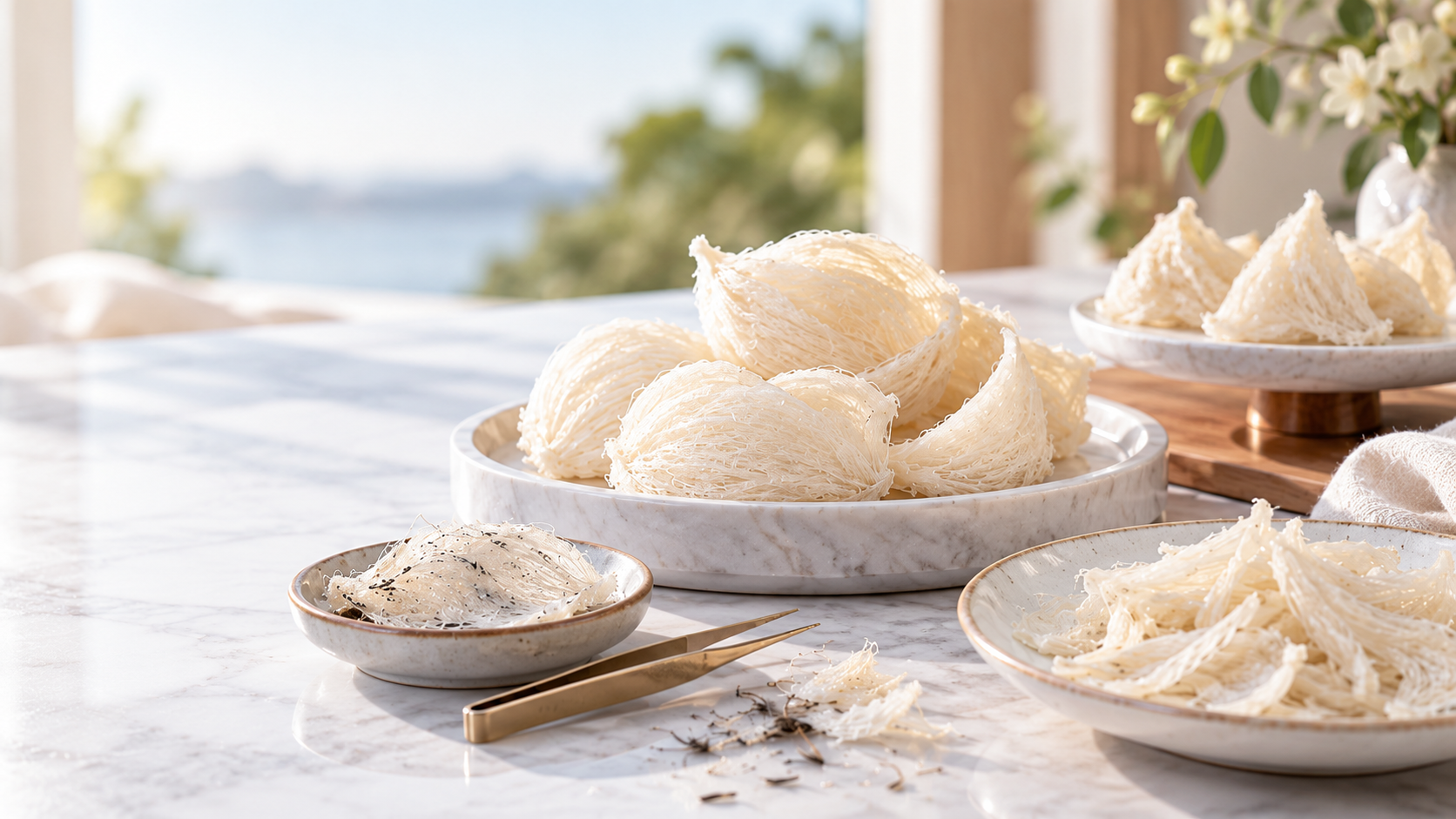
A whole nest with a neat half-cup shape. Bowl nests look the most refined, which makes them the most sought after and the most expensive grade.
Corner and triangle
Nests built in the corners of the wooden beams inside a swiftlet house. They are thicker on one side, with fine strand quality, and usually sell just below bowl nests.
Broken pieces
Fragments that break during harvest or cleaning. The strands are the same material, so broken pieces are popular for drinks, desserts and food manufacturing at a lower price per kg.
Bird Nest Price per Kg, Raw Versus Cleaned
Raw nests still contain feathers and debris, while cleaned nests have been picked and washed by hand. Cleaning removes weight, so a cleaned nest always costs more per kg.
Hand-cleaning is careful, slow work. Each feather is lifted out with fine tweezers, and the strands are then reshaped and gently dried. Researchers have estimated it can take one person eight hours to clean just ten nests. Because some weight is lost along the way, a kilogram of cleaned nest starts as more than a kilogram of raw nest.
Recent Indonesian reporting gives a sense of farm-gate prices. In July 2026, collectors in Lubuklinggau were paying about Rp8 million per kg for raw bowl nests, compared with Rp5 million to Rp7 million before. Corner nest rose to about Rp6 million per kg, up from Rp5 million. These are regional figures for raw nests, and prices vary widely between areas and harvests.
At the other end of the chain, the price climbs steeply. A premium white nest sold through a US online grocer was listed at US289per100grams,andrestaurantsoftenchargebetweenUS40 and US$100 for a single bowl of soup. If you’d like to explore that dish, our bird’s nest soup guide covers its origins and price.
What Moves the Market in 2026
Weather and harvest
Long dry spells and haze reduce the number of swiftlets nesting. In mid-2026, some Indonesian farmers reported harvests falling by around half, and market prices rose as a result.
Export demand
China remains the main destination. Industry data reported by Indonesia’s public broadcaster RRI puts Indonesian exports of swiftlet next to China at roughly 400 to 500 tonnes a year. Indonesia’s Ministry of Trade noted in 2021 that nests sold to China could fetch more than US$1,500 per kg, far above destinations with looser rules.
Registration and compliance
Indonesia continues to encourage registered swiftlet houses and local processing. By June 2026, the quarantine agency Barantin had recorded 4,204 registered swiftlet houses, and 50 companies were listed in China’s import registration system. Compliant supply chains cost more to run, which is reflected in the price of export-grade nests.
Why a Very Low Price Deserves a Second Look
A bargain is not always a bargain. Testing laboratories have documented nests being whitened with hydrogen peroxide, and salt or calcium carbonate being added to increase weight. Researchers have also found karaya gum, red seaweed and tremella fungus mixed into retail nests. Some of these additions look identical to genuine nests, so laboratory testing is the most reliable check.
The authentic nest has a soft ivory tone rather than a paper-bright white. Every Alba nest is cleaned by hand with clean water, with no chemical bleaching. You can follow each step on our production process page and review our certifications and permits.
What You’re Paying For
The value of an edible bird’s nest lies in its glycoprotein, and sialic acid is its signature component. Scientists also use sialic acid as a marker of genuine nest content. Our article on sialic acid in bird’s nest explains what it is and what the research shows.
Frequently Asked Questions
How much does an edible bird’s nest cost per kg?
It depends on grade and condition. In July 2026, raw bowl nests were sold to collectors in one Indonesian region for about Rp8 million per kg. Cleaned, export-ready nests cost considerably more, and retail prices in the United States can reach several thousand dollars per kg.
Why do bird nest prices change so often?
Prices respond to harvest conditions, weather, demand from China and changes in quarantine and registration rules. A shift in any of these can move prices within weeks.
How can I tell if a cheap nest is genuine?
Look for a natural ivory colour, strands that expand evenly when soaked and a supplier that can name its source. A certificate of analysis from an independent laboratory is the strongest proof.
Can I import bird’s nests into the United States or Australia?
Yes, from a compliant exporter. US entry requires heat treatment that meets USDA APHIS conditions, and Australia applies its own conditions under the Biosecurity Act 2015. Alba operates an FDA-registered facility and holds NKV veterinary certification in Indonesia.
Request a Wholesale Quote
Whether you’re stocking a retail shelf, supplying a restaurant or developing a bird’s nest product, the right grade at a fair price starts with a trusted source. Browse our premium bowl, corner and strip nests or contact our team for current wholesale pricing.